
Artificial intelligence is on everyone’s lips. Touted as the silver bullet for many business challenges, it has become a true buzzword. But in practical terms, what does AI bring to human resources? What are the associated risks, particularly regarding data security and decision transparency? And how can you integrate high-performance AI into your HRIS without compromising compliance or employee trust? Discover four real-world use cases of AI applied to HRIS.
Creating Job Descriptions: AI to Support Your Hiring Process
Writing attractive and accurate job descriptions is an essential—but often tedious—step in the recruitment process. By integrating generative artificial intelligence into your HRIS, this task becomes fast, personalized, and, above all, incredibly effective.
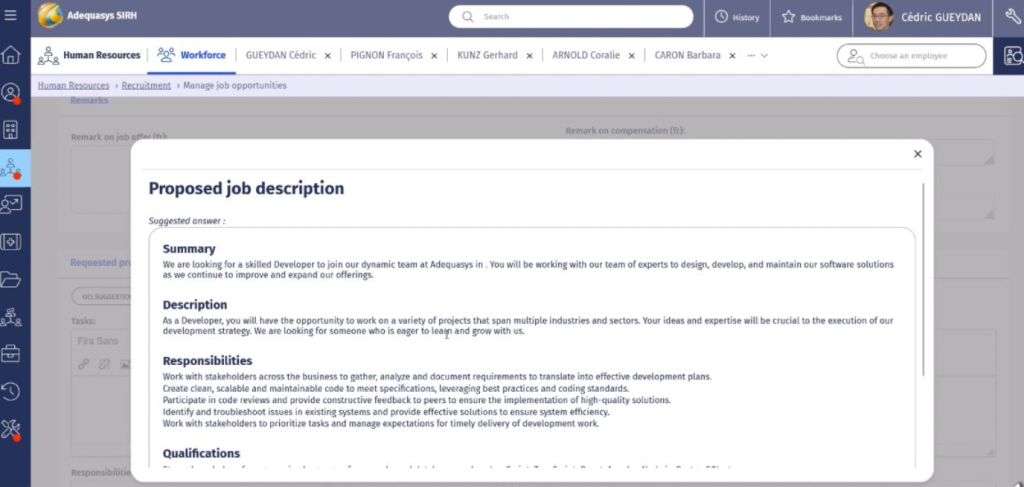
In just a few seconds, AI can generate a clear, well-structured job posting tailored to the specific requirements of the position, while aligning with your company’s culture. It draws on existing data to extract the most important information, highlighting the required skills, key responsibilities, and benefits of the position.
This automation frees up valuable time for recruiters and managers, allowing them to focus on reviewing applications rather than drafting them. It also helps maximize the visibility of job postings by making it easier for them to rank on search engines such as Google, Bing, and Indeed. The result: greater appeal, wider reach, and candidates who apply more quickly.
Suggestions for Annual Goals: AI for Clearer Pathways
Writing attractive and accurate job descriptions is an essential—but often tedious—step in the recruitment process. By integrating generative artificial intelligence into your HRIS, this task becomes fast, personalized, and, above all, incredibly effective.
In just a few seconds, AI can generate a clear, well-structured job posting tailored to the specific requirements of the position, while aligning with your company’s culture. It draws on existing data to extract the most important information, highlighting the required skills, key responsibilities, and benefits of the position.
This automation frees up valuable time for recruiters and managers, allowing them to focus on reviewing applications rather than drafting them. It also helps maximize the visibility of job postings by making it easier for them to rank on search engines such as Google, Bing, and Indeed. The result: greater appeal, wider reach, and candidates who apply more quickly.